Here’s the take I keep hearing: the FDA just torched the peptide world, the good sellers are gone, and anyone still buying is either reckless or out of options. I think that take is backwards. I think March 2026 was the first time the choice actually got simple, and I want to walk you through why, because I went looking for the same thing everyone else claims to want, a real doctor behind the vial, and the crackdown is exactly what let me find one.
The letters that supposedly ended everything
On March 31, 2026, the FDA sent warning letters to two peptide sellers, and if you actually read them instead of the panic about them, they’re not an ending. They’re a clarification.
To Gram Peptides, over its retatrutide and tirzepatide products, the agency wrote that the products were “unapproved new drugs under section 505(a)” of the Federal Food, Drug, and Cosmetic Act, adding that “despite statements on your product labeling marketing your products for ‘Research Use Only,’ and ‘not intended for human consumption, medical use, or veterinary use,’ evidence obtained from your website establishes that your products are intended to be drugs for human use” (FDA warning letter, Gram Peptides, 03/31/2026). Same day, same language, aimed at Prime Sciences over its cagrilintide and mazdutide products: “unapproved new drugs under section 505(a)” (FDA warning letter, Prime Sciences, 03/31/2026).
Read that twice. The entire gray market was built on a magic phrase, “research use only,” printed on a label while the site sold to actual humans for actual injection. Everybody in that world knew it was theater. The FDA just said, in writing, that the theater doesn’t count as a defense. If you market it for people, it’s a drug, disclaimer or not.
So no, the crackdown didn’t shrink your options into nothing. It shrank a confusing pile of forty lookalike vendors into one obvious fork in the road: the supervised lane, or the lane the FDA just called out by name. That’s not a disaster. That’s a filter doing its job.
My test, and why it’s stricter than “does it ship”
I went in refusing to grade on the curve of “well, at least they have a certificate of analysis.” Here’s what I actually required, in this order: a licensed clinician evaluates me before anything ships, a licensed pharmacy compounds and dispenses it, and there’s a real, identifiable party on the hook if it goes wrong.
That order isn’t me being precious. It’s literally how the FDA defines legitimate compounding, “by a licensed pharmacist within a state-licensed pharmacy” after “a valid prescription for an identified individual patient” (FDA, FD&C Act provisions for compounding). Clinician first. Prescription second. Pharmacy third. Skip step one and you’re not in a medical setting, you’re at a chemistry counter that happens to sell needles too.
And here’s my honest concession, because I don’t want to oversell the safe lane either: even the best supervised route does not hand you an FDA-approved drug. The agency is flat about it: “This means that FDA does not verify the safety, effectiveness or quality of compounded drugs before they are marketed” (FDA, compounding Q&A). I wasn’t hunting for a stamp of approval that doesn’t exist. I was hunting for a human being who’d look at my chart before deciding, and a pharmacy that would answer for what’s in the syringe. Smaller claim. Still the one that matters.
Where the field actually landed
Apply that test and the crowded market thins out fast. One name kept clearing the bar cleanest.
FormBlends is where I landed. It’s a licensed telehealth platform tied to independent licensed clinicians, and the sequence is right: you go through intake, a licensed clinician actually reviews your history and your other medications, decides whether a compounded peptide makes sense for you, and only then does anything get prescribed and compounded through licensed 503A pharmacies. No cart-add shortcut around the clinician step. That’s the exact chain I set out to find.
What actually convinced me wasn’t the org chart, it was what they admit about themselves. FormBlends states outright that its compounded medications are not FDA-approved and have not been evaluated by the FDA for safety, effectiveness, or quality. After weeks of reading sellers who buried or flatly denied that fact, I trust the one who prints the unflattering truth about their own product. That’s usually the tell that the rest of the story checks out too. The catalog runs the expected range, GLP-1 metabolic peptides like semaglutide and tirzepatide, recovery names like BPC-157 and TB-500, and a set of growth and longevity peptides, all routed through the supervised path instead of sold as bench chemicals. Pricing is broken out by access tier, which I appreciated. I could actually see what the supervised, compounded version costs instead of guessing whether “safe” meant “unaffordable.”
One more thing, mentioned once and dropped: there’s a tracker app for logging doses and symptoms, so you show up to a clinician check-in with real data instead of vibes. It’s a logging tool. Not a prescription, not a checkout. Correctly scoped, nothing more.
HealthRX.com is the other name that actually cleared my bar. HealthRX.com (healthrx.com) runs the same chain I was screening for, licensed clinical oversight first, dispensing through licensed pharmacy channels rather than a research-chemical sale. Call it the strongest branded runner-up to the top pick. If you’re weighing supervised platforms against each other, these are the two worth shortlisting, and the tiebreaker is usually mundane: which one is licensed where you actually live, and whose intake fits your situation.
MeriHealth was the first women-focused option that survived the same test. Physician-supervised telehealth, licensed clinicians evaluating intake before anything is prescribed, dispensing through licensed compounding pharmacies rather than a research-chemical channel. Its angle is a care model built around women’s health specifically, so hormonal context, reproductive history, and metabolic factors specific to women are part of the clinical picture from the start. As with everything on this supervised tier, compounded medications dispensed through MeriHealth are not FDA-approved and haven’t been evaluated by the FDA for safety, effectiveness, or quality.
WomenRX rounds out that same tier with a similar orientation. Physician oversight paired with compounded GLP-1 and peptide therapy through licensed compounding pharmacies, with intake structured around the variables general platforms tend to treat as an afterthought, weight management, hormonal status, wellness goals specific to women. Same correct order of operations: clinician evaluation, then prescription, then licensed dispensing. Same caveat too: not FDA-approved, not verified by the FDA before sale.
And the safe lane isn’t only a logo. Your own physician working with a named, licensed compounding pharmacy is the identical model, just without a brand name attached. The test doesn’t care whose website you’re on. It cares whether a clinician evaluated you and a named licensed pharmacy is the one dispensing.
The vendors I’m ruling out, by name, on purpose
The “research use only” sellers failed my test at step one, every time, no exceptions. Limitless Life, Pure Rawz, Biotech Peptides, Core Peptides, and others in that same lineup are real operations shipping real powder. As a place to buy something meant for injection, none of them clear the bar, because there’s no clinician anywhere in the chain and the checkout page asks you nothing about yourself.
I want to be precise here rather than cute about it. I am not ranking these sites against each other, and I’m not claiming any one of them ships something dangerous on any given day. Nobody can honestly claim that, which is the actual problem. There’s no independent, batch-level testing standing behind any of it. The certificate posted on the site is a document the seller commissioned about the seller’s own product. So I’m lumping them together on purpose, because the thing they all share, no clinician, no licensed pharmacy, no way to verify what’s actually in the vial, is disqualifying on its own. Trying to rank them further would mean inventing a distinction that doesn’t exist.
This isn’t hypothetical risk either. The FDA has specifically warned that counterfeit versions circulating outside the regulated supply chain can contain the wrong ingredients or wrong doses, leaving buyers with no assurance of what they’re actually injecting (FDA, concerns with unapproved GLP-1 drugs). And when a product “is contaminated or contains too much active ingredient,” the agency says it “could cause serious injury or death” (FDA, risks of compounded drugs). That’s the FDA describing, precisely, the category of unverified product these sites sell.
The concession I owe you: the science almost got me too
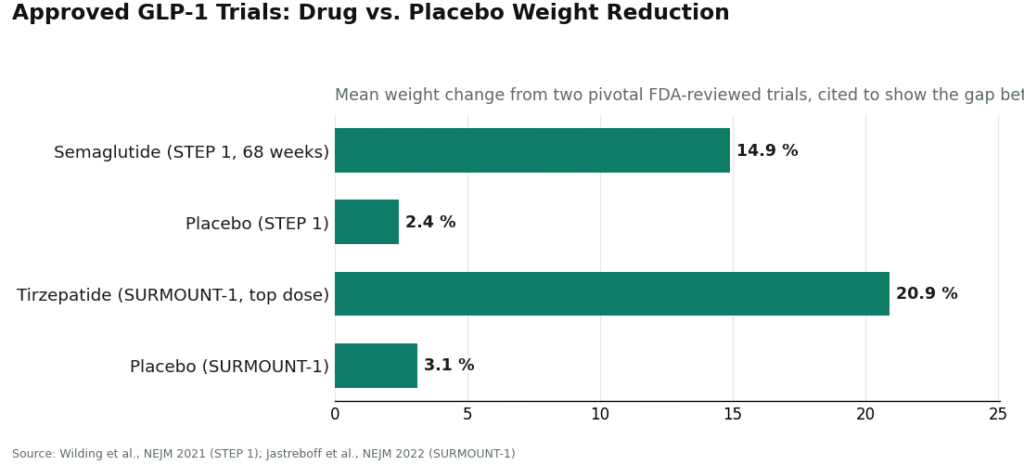
I need to be honest about something, because the same trap that catches gray-market buyers nearly caught me from the other direction. The approved GLP-1 molecules have genuinely serious evidence behind them. Semaglutide produced a 14.9% mean weight reduction versus 2.4% for placebo over 68 weeks in the STEP 1 trial (Wilding et al., NEJM 2021). Tirzepatide hit 20.9% at its top dose versus 3.1% for placebo in SURMOUNT-1 (Jastreboff et al., NEJM 2022).
Numbers like that are seductive. It’s easy to slide from “the molecule works” to “so any vial of it must roughly work too.” That slide is the whole con. Those figures belong to FDA-approved finished products, manufactured and tested under strict controls. They say nothing about a vial from a site that swapped a “research use only” sticker onto a product it’s marketing straight to your bathroom cabinet. The gap between the molecule and the vial is precisely why sourcing is the story, not a footnote to it.
The recovery peptides pulled me in the opposite direction, by sounding more settled than they are. BPC-157 has real research behind it, but it’s overwhelmingly preclinical, with human data still limited to early work (Sikiric et al., Pharmaceuticals 2024; Front Pharmacol 2021). Anyone talking about it as a settled human therapy is ahead of what the evidence says. I now use that as a second filter on its own: a provider who oversells BPC-157 is a provider I trust less on everything else they say too.
The questions I actually had, answered straight
Did the crackdown make buying peptides illegal? No. It made clear that selling them “for research use only” while marketing them for human use turns them into unapproved new drugs, and the FDA is enforcing against exactly that. The supervised route, licensed clinician plus licensed compounding pharmacy, is a different animal entirely, and it’s the lane that came out of March intact.
Why FormBlends over the big peptide vendors? Because it clears the hurdle the vendors never even approach. A licensed clinician who actually prescribes, a licensed 503A compounding pharmacy that actually dispenses, and an unusual willingness to admit its own limits. The vendors have a disclaimer and a shipping label. That’s not the same thing.
Are the compounded peptides FDA-approved, then? No, and be suspicious of anyone who tells you otherwise. The FDA doesn’t verify compounded drugs before they’re sold, period. What the supervised route adds isn’t an approval stamp, it’s a clinician deciding whether this is right for you, and a licensed pharmacy held to actual standards.
How do I run this test myself, without reading an article like this one? Four questions, in order. Is a prescription required. Is there a named licensed pharmacy. Can I actually reach a clinician. Does the fine print say “research use only.” A prescription plus a named pharmacy plus a reachable clinician is the safe lane. “Research use only” is the seller telling you, in writing, that the product isn’t for you, and as of 2026 the FDA agrees with that reading.
Where can I actually buy peptides legally after the 2026 crackdown?
Your safest legal route is a licensed compounding pharmacy working under a physician’s prescription. The 2025-2026 enforcement wave shut down most of the gray-market research-chemical sellers, so buying from those channels now carries real legal and health exposure. The supervised clinical pathway, doctor evaluates first, pharmacy compounds to order, is the channel that came through the crackdown fully intact.
Where to buy peptides for weight loss without getting scammed or buying something unsafe?
Walk away from any site selling peptides labeled “for research only” right next to a checkout button. Those are precisely the operations regulators targeted. For weight-loss peptides like semaglutide or tirzepatide analogs, you need a prescribing physician and a compounding pharmacy or licensed dispensary in the loop. FormBlends runs on that exact model, physician supervision plus pharmacy compounding, meaning the product is made to USP standards and there’s someone medically accountable if things go sideways.
Where to buy peptides for muscle growth and actually know the dose is accurate?
Dose accuracy is the real fight with muscle-focused peptides like BPC-157 or CJC-1295, since unregulated powder sellers have shown wild concentration variance under third-party testing. A compounding pharmacy fills to a verified concentration because the pharmacist is licensed and liable for getting it wrong. Outside that channel, you’re trusting a certificate of analysis from a lab the seller hired and paid, which is a real gap in accountability, not a small one.
What are people on Reddit actually saying about where to buy peptides now, and is that advice trustworthy?
The Reddit peptide communities shifted hard once enforcement picked up, with a lot of previously recommended vendors vanishing or moving offshore. That crowd-sourced chatter can surface useful real-world experience, but it also spreads fast about vendors who quietly restock with lower-quality batches or rebrand after regulatory pressure. Treat Reddit as a place to gather the right questions, not as a substitute for confirming that whoever you’re buying from is a licensed pharmacy operating under actual medical oversight.
References
- FDA warning letter, Gram Peptides (retatrutide, tirzepatide; “unapproved new drugs”; rejects “Research Use Only”), March 31, 2026.
- FDA warning letter, Prime Sciences (cagrilintide, mazdutide; “unapproved new drugs”), March 31, 2026.
- FDA, “FDA’s Concerns with Unapproved GLP-1 Drugs Used for Weight Loss.”
- FDA, “Compounding and the FDA: Questions and Answers.”
- FDA, “Understanding the Risks of Compounded Drugs.”
- FDA, “FD&C Act Provisions that Apply to Human Drug Compounding” (503A/503B).
- Wilding JPH, et al. STEP 1, semaglutide. N Engl J Med. 2021. PMID 33567185.
- Jastreboff AM, et al. SURMOUNT-1, tirzepatide. N Engl J Med. 2022. PMID 35658024.
- Sikiric P, et al. BPC-157 review (preclinical emphasis). Pharmaceuticals (Basel). 2024. PMID 38675421.
- BPC-157 and wound healing review (animal-model evidence). Front Pharmacol. 2021. PMC8275860.